Buy a Practice Now?

What a crazy time we are in. At least to me, this is a sober reminder that major disrupters are almost impossible to predict. I am reassured that our nation seems to be taking the situation seriously and I do firmly believe we can weather this storm. Most of you reading this have had your professional world rocked. You’ve probably had your hours cut, maybe by 100%. Unemployment is likely a new reality. Fortunately, there is a strong support system in this industry ready to help. Don’t hesitate to reach out. I think you will find all of us willing to go the extra mile right now to help you keep your ship afloat.
Most of you have thought about buying a practice at some point, some of you have been seriously pursuing ownership. There is going to be a lot of advice out there right now saying that it is far too risky to buy a practice and it is better to get/keep a nice safe, secure job. I am going to give you four reasons why you should do exactly the opposite.
One, financing. Interest rates are at an all-time low. Most banks are willing to defer principal payments or even the entire payment for months. Some have even said a year. I’m not going out on much of a limb to say these are the best lending conditions you will see in your career. Historically, there have been periods of higher interest rates. When I was a kid in the early eighties, they were fourteen percent. There have been many times when banks weren’t as generous on the amounts they would lend. One hundred percent financing is not a given.
Two, taxes. The government is going to spend a fortune to deal with this crisis, we have an aging population, new social safety nets will probably be put in place, etc… It is hard to imagine a scenario where taxes don’t go up, maybe way up. Nobody gets hit in a tax hike as hard as a non-business owning high wage earner who makes between $150,000 and $300,000 per year. That $200,000 salary doesn’t look as good when half of it is taken out for taxes.
Three, working for a corporation in a down economy. Corporations aren’t inherently bad entities. Many are fabulous. That said, unless they are a non-profit, they aren’t set up to be a charity. The shareholders and private equity backers are going to demand performance once this crisis is over. If patients hold off on elective treatment, keeping revenue up will require a high volume, much like a Medicaid clinic. You could be expected to see many more patients, in less time, than you currently do. It happened to physicians, it happened to pharmacists, it could happen to you.
Four, time. Odds are you have more free time than normal. No one, especially the bank, is going to expect you to complete a practice purchase before this crisis is over. That said, doing the work now could put you in a position to complete the purchase when the restrictions are lifted and capitalize on the built-up demand, which inevitably will occur.
In the words of Rahm Emanuel, “Never let a serious crisis go to waste. And what I mean by that it’s an opportunity to do things you think you could not do before.”
Read MoreBuy a Practice Now?

What a crazy time we are in. At least to me, this is a sober reminder that major disruptors are almost impossible to predict. I am reassured that our nation seems to be taking the situation seriously and I do firmly believe we can weather this storm. Most of you reading this have had your professional world rocked. You’ve probably had your hours cut. Some of you may even have been laid off. Fortunately, there is a strong support system in this industry ready to help. Don’t hesitate to reach out. I think you will find all of us willing to go the extra mile right now to help you keep your ship afloat.
Most of you have thought about buying a practice at some point, some of you have been seriously pursuing ownership. There is going to be a lot of advice out there right now saying that it is far too risky to buy a practice and it is better to get/keep a nice safe, secure job. I am going to give you four reasons why you should do exactly the opposite.
One, financing. Interest rates are at an all-time low. Most banks are willing to defer principal payments or even the entire payment for months. Some have even said a year. I’m not going out on much of a limb to say these are the best lending conditions you will see in your career. Historically, there have been periods of higher interest rates. When I was a kid in the early eighties, they were fourteen percent. There have been many times when banks weren’t as generous on the amounts they would lend. One hundred percent financing is not a given.
Two, taxes. The government is going to spend a fortune to deal with this crisis, we have an aging population, new social safety nets will probably be put in place, etc… It is hard to imagine a scenario where taxes don’t go up, maybe way up. Nobody gets hit in a tax hike as hard as a non-business owning high wage earner. As a professional, this is you.
Three, working for a corporation in a down economy. Corporations aren’t inherently bad entities. Many are fabulous. That said, unless they are a non-profit, they aren’t set up to be a charity. The shareholders and private equity backers are going to demand performance once this crisis is over. If clients hold off on elective treatment, keeping revenue up will require a high volume. You could be expected to see many more patients, in less time, than you currently do. It happened to physicians, it happened to pharmacists, it could happen to you.
Four, time. Odds are you have more free time than normal. No one, especially the bank, is going to expect you to complete a practice purchase before this crisis is over. That said, doing the work now could put you in a position to complete the purchase when the restrictions are lifted and capitalize on the built-up demand, which inevitably will occur.
In the words of Rahm Emanuel, “Never let a serious crisis go to waste. And what I mean by that it’s an opportunity to do things you think you could not do before.”
Goodwill in Dental Practice Value – For Buyers
By Megan Urban, OMNI Practice Group
As many of you know, in the sale of dental practices, typically the biggest contributor in determining the purchase price is “Goodwill”. Are you aware of the aspects that make up goodwill? Of course, it includes your patients and business reputation, but it’s also based on patient retention, which is your hygiene program or Recare.
Savvy buyers understand that the repeat or retained patients are critical to on-going success. It is also important to lenders working with buyers. If you have a bulk of your patients coming in for large cases and your collections are high, that is commendable, however, a new buyer will be concerned that your patients have completed all treatment leaving them nothing to do and eliminates the chance for the buyer to meet and keep your patients.
All dentists focus on getting enough New Patients, as they should, but what happened to all the New Patients you treated over the years? As a buyer, Recare is consistently an area of opportunity. Even if Recare isn’t where you’d like it, consider what can be done. Take a look at this example:
Let’s say you averaged 15 NPs per month for 10 years and you saw each on an average of twice per year in hygiene or Recare, you would need approximately 514 days of hygiene if you see an average of 7 per day. Some of you may see more patients in hygiene, but some may be SRP and perio patients may be coming every 3-4 months. You may work around 180-195 days per year so you would need approximately 2.75 hygienists. So that means if you retain at least 85% of those patients, you will need more and more hygiene days each year. Is this happening in your practice?
I have analyzed hundreds of practices and found that the average potential for increased collections from goodwill or patient retention is $30,000 to $150,000, depending on the size of the practice. I know it’s usually a high priority in any practice but needs a little tweaking that can bring big increases. And this doesn’t include potential increased collections from diagnosed treatment from all those periodic exams!
Every practice has areas of opportunity and here is one for you to capture.
Read More5 Reasons to Purchase a Practice in 2020
Happy New Year! Is this the year you finally take the plunge and buy your own practice? Or are you content with being an associate working for someone else? Here are a few reasons why 2020 should be the year you become a practice owner:
- Interest rates are starting to move up. The past few years have rewarded buyers with interest rates in the 4% to 5% range and some with as low as 3.75%. Interest rates moving up means you may have higher payments on your practice loan.
- Bank financing is readily available. If you think you cannot get financed because of high student loan debt, personal debt, bad credit, etc., then think again. Banks view your diploma and the accompanying school debt as a positive thing. It’s an asset that can be used to generate a good income. Call us and we can hook you up with a bank to discuss your situation.
- Jump in, the water is warm. Studies have shown that those who are successful in both business and in their personal lives take calculated risks. Owning a practice is a well-calculated risk with the failure rate on practice ownership less than .25%. Yet, many doctors continue to be an associate as they deem practice ownership to be a risk.
- Pay off debt and retire sooner. By purchasing a practice this year versus several years down the road, you can pay off your debt sooner, put more money in your pocket and retire sooner. I know of several examples of doctors who bought a practice two years out of school and five years later had their practice completely paid off and are putting that money towards retirement. Plus, practice owners make an average of 25% more per year than typical dentists who are associate employees in someone else’s practice.
- Become independent. Owning your own practice allows you to do the procedures you want to do and refer out those you do not want to do. It also allows you to choose your staff, even choose your patients. You get to work when you want to work and go on vacation when you want to go on vacation. It is all up to you as you are the boss!
Whether you decide to purchase a practice in 2020 or continue to work as an associate, Omni Practice Group would like to wish you a Happy and Prosperous New Year!
Read MoreAn Ownership New Year’s Resolution
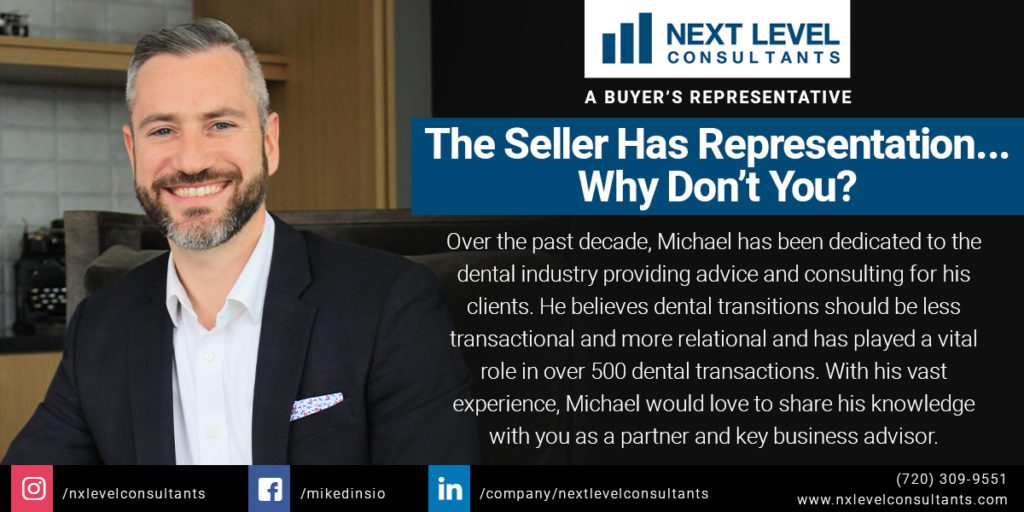
By Michael Dinsio, Next Level Consultants
As a buyers’ representative and business coach, I talk to hundreds of doctors a year. Many themes emerge from these conversations, but the one that pains me the most is hearing how dentists delay considering practice ownership early in their career. Many desire ownership and watch as friends become owners with a thought of maybe someday. But, for themselves, they hope and wait till the “perfect” situation presents itself, if it ever does. As we roll into the new year, my hope is that more doctors get off the bench and into the game. The time for ownership is right now. Here is why.
#1 MONEY is Cheap
As once a dental specific banker, I can tell you interest rates have never been lower. With rates as low as sub 4% on 15 year practice loans, the cost of money is cheap for buyers. What does this mean? Lower payments equal more cash flow. Even with practices being priced higher than historical averages, lower payments offset the cost to make the purchase affordable. The lower payments also allow buyers to invest in new equipment, stronger marketing, and consulting services to set them up for success. These types of investments help buyers confidently take the leap into ownership!
#2 The Market is Primed
For over a decade, industry experts have predicted a slowdown of practice sales. Fortunately for the 25,000+ graduating dentists every year, this has not been the case. I predict that in 2020 more dentists will put their practices up for sale than ever before. Here’s why.
First, in 2020 the average age of the baby boomer generation will hit 65 and they become eligible for Normal Retirement Age (NRA) benefits. As their retirement benefits start to roll in, many will consider selling their successful practices.
Secondly, the stock market is at an all-time high. Last month the market hit another peak, as investors focus on the progress of the U.S.-China trade talks. Overall the Federal Reserve is upbeat and continues to keep interest rates low. For those retiring baby boomers, this means they can comfortably retire with the nest egg they have, not feel pressured to keep working.
Lastly, Washington State continues to increase taxes. Although a capital gains tax has been voted down, it continues to be an annual discussion in Olympia. New and expanding taxes are always a threat. Kitsap Daily News reported that, “Washington is one of seven states with no state income tax, and one of nine without a capital gains tax, making it an outlier among West Coast states.” Governor Jay Inslee released a three-year plan that contained a proposed 9 percent tax on certain capital gains over $25,000. Sellers may have dodged a bullet this time, but many owners will consider selling sooner to avoid the looming threat of higher taxes.
#3 TIME is valuable
It’s not a secret that small investments over the long term will yield more than large investments over the short term. In short, time is on your side. Working as an associate definitely has some benefits. The corporates make sure of that. With that said, the ownership opportunity dentists have in front of them is difficult to quantify. Just like a mutual fund or a piece of property, dental offices have real value. When my clients choose ownership, they are not only benefiting paycheck to paycheck, but they are also building real value in an asset to sell in the future.
I recently had coffee with a dentist and an old friend. In 2012, when I first met her, she was considering buying an office. I remember the first practice she looked at: it was in a desirable location, the equipment was in good shape and the financials were average. Despite my recommendation to buy, she ultimately passed on the opportunity.
When we sat down, she was so excited to tell me that she just received news of an accepted letter of intent to purchase her first practice. While I’m excited for her, the delay of 8 years got me thinking. If she had purchased in 2012, by now her initial loan would have likely been paid off and her business would most likely have surpassed a million in revenue. Eight years of lost income and equity over trying to find “the perfect practice.”
As a New Year’s Resolution, resolve to take your career into your own hands. The average associate struggles to make ends meet juggling two to three associate positions. For all that hard work, their income ranges anywhere from $120,000 to $150,000 per year and they have less than $25,000 dollars in savings. Yes, becoming an owner is daunting, but the statistics speak for themselves. Default rates remain lower than ever in this industry. The money is right, the market is primed, and time is ticking.
Make the decision in 2020 and invest in yourself!