
Get in the Game
Well, GET IN THE GAME! I’m not talking about football, I’m talking about reaching your potential and owning your own veterinary practice. Too many doctors sit on the sidelines waiting for the perfect opportunity to go in. You need to create your own opportunity. An opportunity to show and improve your skills by purchasing or starting your own practice. I know several doctors who I’ve been “thinking about” a practice or a startup location for 7+ years! If they would have purchased the first practice they considered, their practice would be almost paid off and worth over $500,000. That’s an opportunity cost of a half million dollars. Let me say that again in another way, you threw away $500,000!
I know everyone’s situation is different, but we have shown a lot of practices and start-up locations to doctors where those practices and locations were picked up by another doctor. That doctor got in the game and grew those practices in some cases to over $1 million. On average practice owners make 20% more than employee veterinarians, retiring with $400,000 more in their pocket.
If you’re still undecided after this pep talk, give us a call and we’ll be happy to coach you through the process. (877) 866-6053
Why Hunting for Comps Isn’t Always the Best Use of Your Time
Guest post by Tommy Leigh, Vegas One Realty
Shopping around for comps before buying a dental practice may seem like a given for some. To find the best staff with the best service and the best customers, it’s going to take some time and effort to figure out which one fits a buyer’s objective. But just like so many things in life, the answer isn’t always tied up in a simple solution. It may take a little more foresight and a different kind of planning to achieve the best possible outcome.
Every Practice Is Different
No matter how similar a practice may look on paper, the reality can be extremely different than it seems. Beneath what appears to be great promises might in fact be such concerns as a high turnover rate or an overall sense of dissatisfaction from both staff and customers alike. Just because a practice is only a few miles away from another and they both look somewhat similar at a glance doesn’t necessarily mean they should be priced similarly. The basics are just that: Basic — and looking at surface-level attributes can only take one so far.
Some Things Can Change
Excluding practices for certain reasons based on an ‘ideal’ model is one way to miss an excellent opportunity. A dental practice with an old-fashioned website or a less-than-optimal layout shouldn’t necessarily be a deal-breaker. A few bad reviews on the structure of appointments does not represent an inherent systemic issue with the practice. Dental practices are often happy to work with potential buyers to ensure they can get their practice up to speed. They may be willing to upgrade their outfit with a few extra perks while taking the time to get their staff up to speed. It may only be a few simple tweaks that need to happen before the deal becomes that much sweeter for the buyer.
Take a Deeper Dive
What may be more prudent is to take a deeper dive into the specifics of client retention rates, prices, and profitability. To really understand a practice, leaders have to perform a deep dive into the numbers behind the practice. While location and presentation are certainly draws, figures such as cash flow will give buyers a better idea of what a practice is worth. Each one of those figures tells a small story that all adds up to the actual worth of a practice. As with so many decisions, the real devil is in the details so it all starts with taking a hard look at a singular practice. From the state of the technology of the practice to the quality of the furniture in the waiting room, this is the time to discover what makes each practice different from its direct competitors.
Getting ready to buy a dental practice will be a time-consuming process no matter what approach a decision-maker takes, but there are ways to cut down on the amount of back and forth. Rather than starting with an overwhelming amount of potential candidates and then taking the time to painstakingly cross them off a larger list, it may make more sense to look at one promising practice in order to determine the real worth underneath. Make sure to keep an open mind about the ideal features of an ideal practice — they may not always be as obvious as they seem.
Tommy Leigh is the Broker/Owner at Vegas One Realty. Tommy’s team takes great pride in its ability to put clients first and provide the highest level of honesty and expertise in everything they do.
How to Buy a Veterinary Practice
Buying a Veterinary practice is like getting a colonoscopy. You know you should probably do it, but it can sometimes be a pain in the nether region. But just like getting a colonoscopy, it can go very smooth if you follow the right steps and use the right professional. Here are a few steps to consider which can make for happy times in the end. No pun intended.
- Have good clinical skills. Be sure you have the clinical skills to produce the same or more production than the average veterinarian. In other words, don’t buy a practice right out of veterinary school when it takes you four hours to do spay or neuter a dog. It can take up to 5 years to learn the clinical and management skills to run a practice.
- Buy existing or Startup new. Decide if you want to start up a new practice, or buy an existing practice. We recommend start by looking for an existing practice in the area you’d like to practice. If after a period of time you cannot find a practice and the numbers make sense in your location of choice, analyze doing a startup. Cash flow is king in veterinary practice financing and in paying your student loans, so look for an existing practice first and then look at doing a startup.
- Veterinary Professional Team. Get professional help from professionals that specialize in the veterinary field. This includes your attorney, CPA, Banker and Broker. Just like you don’t want your plumber doing your colonoscopy, you don’t want a bankruptcy attorney helping you with your veterinary practice purchase and sale agreement.
- Educate yourself on buying a practice. Know how to read a financial statement, practice management reports, lease terms, etc., There is a lot of information online, in the Veterinary Forums and other areas where you can get this for free. Your professionals that you will be working with can also help educate you.
- Find your practice. Use the brokers in the area as well as state and local association contacts to find a practice of your choice.
- Stop looking for the Unicorn! Neither a unicorn nor a perfect practice exists. Don’t cross a practice off a list because the carpet is green and you wanted brown. Or, everything else in the practice looks good, but the staff is overpaid. You can’t glue a pointy horn on a horse and call it a unicorn. But, you can change the carpet, paint the walls, reduce staff pay, add endo to the practice, etc. You will be in the practice for a long time, so don’t poo-poo the practice because of a change that the practice can handle.
- Gather practice documents. At a minimum, you want the following:
- 3 years tax returns
- 3 years profit and loss statement
- 3 years production by procedures and production by provider report
- Copy of the current lease and any amendments
- Practice statistics report showing patient demographics and other information
- Aging balance
- List of Staff salaries and benefits
- Any associate agreements
- List of any vendor contracts
- List of equipment
- Fee Schedule
- Consider your offer. So you like most everything about the practice and you want to make an offer. You can work with your professional veterinary broker, or consultant and put together an offer. You’ll want to analyze the purchase price. If you’ve educated yourself, you can do this on your own. If not, you can use a veterinary professional broker, CPA or consultant to help you put the offer together. The offer is in the form of a Letter of Intent.
- Get a Loan. Banks love veterinarians. The failure rate is less than .0125%. Being a successful veterinarian is like finding a coffee shop in Seattle. It’s pretty hard to miss. Ask your broker, attorney, consultant, etc., for a referral to a lender. Use someone reputable who does veterinary practice financing. Do not use Suzie Q or Jonny Public the local commercial banker. She will treat it like any other commercial transaction and try to run it through the SBA ending poorly with high fees.
- Completing Due Diligence. After you have agreed to a purchase price and both parties have signed a letter of intent, you will want to schedule due diligence in the office. Prepare ahead of time for due diligence. Know which reports you want to run and what the plan is for the due diligence. You’ll want to truly see what the active patient count is. You will want to review charts. You will want to take a closer look at the equipment. I would also suggest seeing if the seller is available for lunch, or to at least come into the office after due diligence. This will help you get all of your questions answered by the doctor himself/herself.
- Preparing to Transition. The real work begins here as far as the transition goes. There are somewhere between 50 to 70 items to get done prior to the closing of the sale. We have a checklist if you’d like to see it. This includes everything from setting up a legal entity to getting insurance credentials to ordering a credit card terminal.
- Staff. All through the process, the staff is hopefully unaware there is a sale going on. The meetings and due diligence have happened in the dark of night, or on weekends all while wearing camouflage. Kidding about the camouflage. The reason the staff is not informed of the sale is there is a potential they may leave. Part of the goodwill of the practice is staff. If they all leave, there may be a potential loss of goodwill. We recommend the seller tell the staff when there is a 99% certainty the transaction will go through to closing. Sometimes that may mean a month before closing and other times it may mean the day of closing. Every transaction, every staff, and every veterinarian is different. It’s a gut feeling we get from experience. Consult with your professional.
- Closing the Sale. Awe, the day is finally here. It’s similar to any major purchase such as a house. Some transactions require an escrow company or attorney to handle the closing. Others can be done by a broker. You will sign the purchase and sale agreement, bill of sale, closing certificate, loan documents and other agreements. It’s a pretty painless process.
- Notifying Patients. As with staff, patients are not notified until the contracts are signed and the money is in the bank. We don’t notify patients as they may leave the practice just as staff may leave. There is a patient letter that is worked and agreed on between the seller and buyer. The cost is typically split 50/50 between the buyer and seller.
- Post Sale. If the practice is running well, do not make any major changes for 6 to 12 months. The more changes make the staff and patients uncomfortable. Go in keeping things business as usual. Of course, if there is an ugly orange shag carpet with teal painted walls, by all means, bring the décor up to date. Also, if the practice is on a downward trend, you may need to make major changes including letting a staff member or two go, adding procedures, etc. You need to make sure it will be successful and again, your veterinary professional advisors can help you.
Following these steps will make your acquisition of a practice a smooth process and not be a pain in the end (get it?). Because you want to step into your new practice with a smile on your face on your first day and not looking like you just had a colonoscopy.
Where to Own a Practice
If you’re in it because you love being a veterinarian and love helping patients and not necessarily in it to make the big bucks, you can really practice almost anywhere. A lot of buyers seem to want the downtown metropolitan practice thinking it’s a great place to practice since there are so many potential patients and you can live the urban lifestyle. We’ve helped doctors who absolutely wanted to be in a metropolitan area, even though the demographics made no sense whatsoever, who then started a practice and did quite well. One doctor that we helped always dreamed of owning a practice in a particular city. He went for it and is successful. And we have seen others want a practice in a certain area, and although the numbers didn’t make sense, they did it anyway and were successful.
Some of you are buying a practice because you want to make a lot of money, in which case, further analysis and discussion is needed. The failure rate for veterinarians is somewhere around .015%. If you’re buying an existing practice and the practice already has good cash flow that you’ve identified, you can purchase the practice and have success almost no matter where it is. If it’s a poor performing practice, you would need to examine if the poor performance is because of the location, the management, or something else. If you want to buy an existing practice and are looking for an opportunity to grow and have lower overhead, I would suggest looking outside of the metropolitan areas. Those areas have less competition, wages and rent are lower and it’s easier to grow those practices. And if you are considering doing a startup practice, the same rules apply. Look for a location with good demographics outside of metropolitan areas. Of course, if you absolutely want to be in a metropolitan area, don’t be afraid to go for it. Just look closely at the numbers and hire a good veterinarian practice or real estate broker to help you out.
One of the advantages of working with Omni is we have both practice brokers and real estate brokers to help you traverse the ownership trail in any way we can. Just give us a call at 877-866-6053 or email info@omnipg-vet.com and we’ll be happy to help get you started.
Cash (Flow) Is KING
Cash is king is an old adage used to describe one of the keys to success in business as well as personal finances. Cash is essentially physical money or liquidity you have available. While cash may be king when it comes to having cash on hand, another vitally important ingredient to the success of a practice is Cash Flow. Cash Flow is the amount of money you have available in a given time period after you have paid all of your expenses (payroll, lab, supplies, debt, etc.).
When analyzing a practice, how do you know how much true cash flow the practice has available? You cannot simply look at a practice’s tax return or a profit and loss statement and know how much cash flow the practice has. There are a number of steps that someone evaluating a practice would take into consideration when determining the correct cash flow. Those steps are as follows:
- Start with the Net Income of the practice. This is the total revenue or collections minus the total expenses.
- Add back the owner’s salary and any taxes associated with the owner’s salary.
- Go through the expenses and “add back” those items that are non-essential to the practice. These are expenses that are for extra-curricular or out of the ordinary expenses. These typically include travel, staff meetings, interest, depreciation, owner life insurance, etc.
- Calculate what your debt service payments will be by using a mortgage amortization calculator. You can use bankrate.com or another online calculator. Use a conservative interest rate based on current market rates for practice loans and a 7-year term. Subtract the debt service payments from the above 3 items.
- The result will be the cash flow to the practice after debt service based on the current state of the practice. This will be how much is available to a potential buyer for his/her personal salary, upgrades, updates, etc.
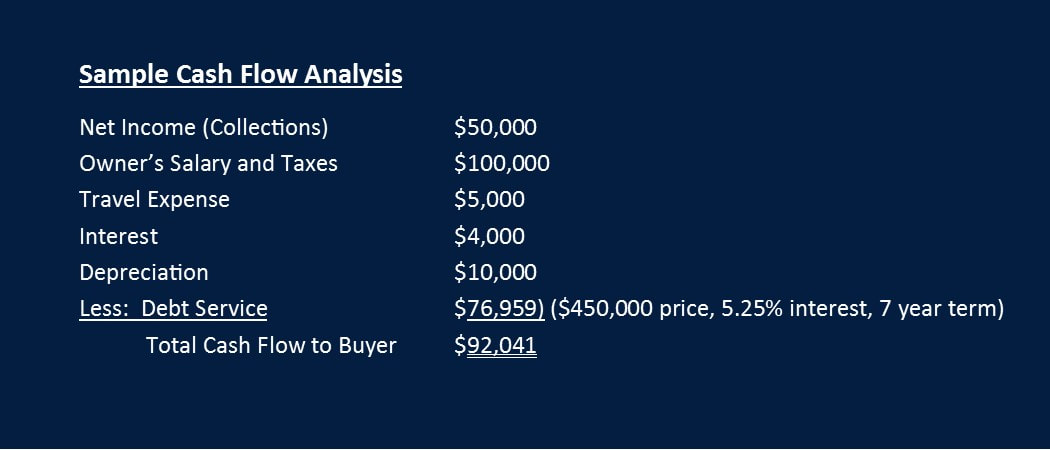
This Sample Cash Flow Analysis shows that without changing a thing, you will earn $92,041 from the practice after paying the note payment on the loan. Note that you can’t stop here. If the cash flow looks low, there may be a reason. The current state of the practice may not be the best run practice. Perhaps salaries are too high, the owner uses the most expensive vendors, or they employ a family member to clean the office at a high salary. There may also be procedures in the practice that the current doctor does not do, but you can. If you keep looking at a low cash flow practice and know how to fix the problems, you may have stumbled upon an incredible opportunity.
If you need help analyzing the cash flow of a practice, or how you can improve a practice, you can call us anytime for a free consultation. We can be reached at (877) 866-6053 or email at info@omni-pg.com.
Correction: In a previous version of this post, Net Income was incorrectly labeled Gross Income in the calculation of Cash Flow. We apologize for the error and any confusion.