
Omni Practice Group and Reasor Professional Dental Services Announce Merger
KENMORE, WA – Omni Practice Group is happy to announce the merger of its business with Reasor Professional Dental Services. The merger has been effective since January 1, 2018.
“Our combined years of service and diverse knowledge and expertise will allow us to provide an even greater service to our clients,” says Rod Johnston, Principal Broker at Omni Practice Group.
Omni has had a strong presence in the Northwest since 2004 and is based in Washington State. Reasor Transitions is based in Oregon and has been providing transition services to the Northwest since about the same time. Omni Practice Group is now licensed to sell practices and provide real estate services in Washington, Oregon, Alaska, Idaho, California, Arizona, Montana and Nevada. Buck Reasor will continue to work under the joint company’s name, Omni Practice Group. Omni Practice Group is excited to have Buck Reasor join their team.
More information about Omni Practice Group can be found here: omni-pg.com.
Contact:
Rod Johnston, MBA, CMA
Omni Practice Group
6141 Bothell Way NE #301, Kenmore, WA 98028
(877) 866-6053
Cash (Flow) Is KING
Cash is king is an old adage used to describe one of the keys to success in business as well as personal finances. Cash is essentially physical money or liquidity you have available. While cash may be king when it comes to having cash on hand, another vitally important ingredient to the success of a practice is Cash Flow. Cash Flow is the amount of money you have available in a given time period after you have paid all of your expenses (payroll, lab, supplies, debt, etc.).
When analyzing a practice, how do you know how much true cash flow the practice has available? You cannot simply look at a practice’s tax return or a profit and loss statement and know how much cash flow the practice has. There are a number of steps that someone evaluating a practice would take into consideration when determining the correct cash flow. Those steps are as follows:
- Start with the Net Income of the practice. This is the total revenue or collections minus the total expenses.
- Add back the owner’s salary and any taxes associated with the owner’s salary.
- Go through the expenses and “add back” those items that are non-essential to the practice. These are expenses that are for extra-curricular or out of the ordinary expenses. These typically include travel, staff meetings, interest, depreciation, owner life insurance, etc.
- Calculate what your debt service payments will be by using a mortgage amortization calculator. You can use bankrate.com or another online calculator. Use a conservative interest rate based on current market rates for practice loans and a 7-year term. Subtract the debt service payments from the above 3 items.
- The result will be the cash flow to the practice after debt service based on the current state of the practice. This will be how much is available to a potential buyer for his/her personal salary, upgrades, updates, etc.
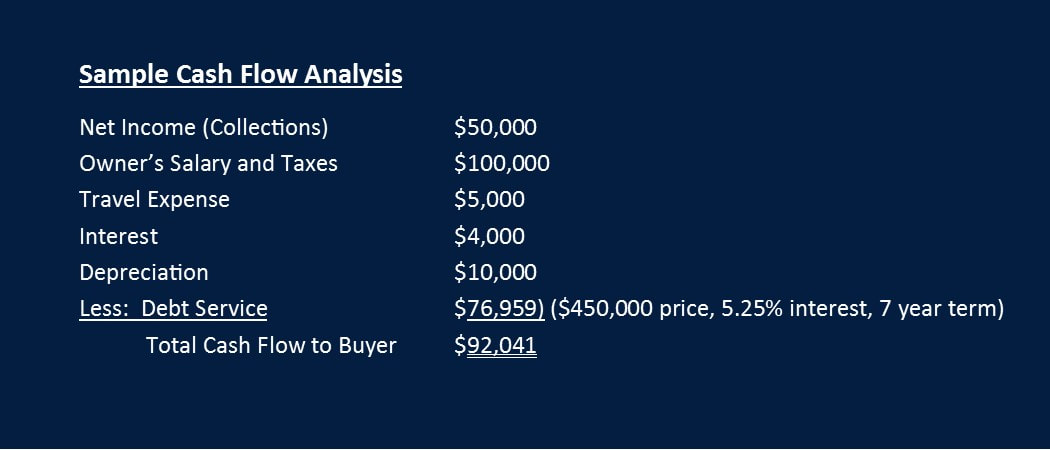
This Sample Cash Flow Analysis shows that without changing a thing, you will earn $92,041 from the practice after paying the note payment on the loan. Note that you can’t stop here. If the cash flow looks low, there may be a reason. The current state of the practice may not be the best run practice. Perhaps salaries are too high, the owner uses the most expensive vendors, or they employ a family member to clean the office at a high salary. There may also be procedures in the practice that the current doctor does not do, but you can. If you keep looking at a low cash flow practice and know how to fix the problems, you may have stumbled upon an incredible opportunity.
If you need help analyzing the cash flow of a practice, or how you can improve a practice, you can call us anytime for a free consultation. We can be reached at (877) 866-6053 or email at info@omni-pg.com.
Correction: In a previous version of this post, Net Income was incorrectly labeled Gross Income in the calculation of Cash Flow. We apologize for the error and any confusion.
Washington Veterinarian Practice Transition Symposium – Practice Foundations

Practice Foundations
Suncadia Resort
Saturday, May 19
Reserve your spot today! https://veterinary-transitions.eventbrite.com
Brought to you by Omni Veterinary Practice Group, Bank of America Practice Solutions and Patterson Veterinary Practice Solutions
Topics Covered:
- What does today’s marketplace look like for selling your veterinary practice?
- Tax strategies for a successful transition of your practice into retirement
- What should you take to prepare for a proper transition of your practice?
- What legal issues should you be aware of in a transition?
9 am to 5 pm. Dinner will follow shortly afterward.
Attendance cost for you and your significant other: $300
Refreshments, lunch, and dinner included.
Deluxe Lodge Guestroom Negotiated rate available for attendees.
More info & registration: https://bit.ly/practicefoundations
Are you ready for your next practice?
If you’re thinking of buying another practice, here are some benchmarks to consider. Note: there may be special exceptions, but this will give you a more stress-free acquisition.
1. Your current practice should be producing between $80,000 and $100,000 per month.
2. Your hygiene program should have production at 25% to 30% of total collections (for general dental practices).
3. You should be getting a new patient flow of 20+ new patients per month.
4. You should have a stable staff with little to no turnover and a good working team.
5. Systems should be in place so your practice can run without you.
6. You have mastered dentistry where you can do most procedures and not refer much work out.
7. Your finances are in good order. You have paid your loans down and you have savings. (See Wikipedia for the definition of savings.)
8. Your spouse or significant other is okay with you opening another location. Realize that two locations = double the work, potential less spouse and family time.
9. You know how to read financial statements. With multiple locations, you now own a business and need to know how to run one.
10. Your bank, financial planner, accountant and other advisors are in agreement that it would be a good idea to start or buy another location.
By following these guidelines, you will save yourself, your family, bankers, attorneys, lawyers and others a lot of grief should you jump into another location too soon. We are always happy to help you assess your situation. Call us anytime, for any reason at no charge- (877) 866-6053.
Preparing your practice for sale

by Jim Vander Mey
Practice Transition Advisor
- Assess your equipment. Upgraded practices sell faster. If you are more than five years away from retirement, I recommend a few upgrades such as recover your chairs if needed and freshen up the paint. If you want to sell in less than five years, stick to the paint and carpet because you will not get the tax benefit of major upgrades.
- Clean up your accounts receivable. Reimburse patient credits, collect old accounts and keep the A/R current.
- If you have an associate, make sure you have an associate agreement with a non-compete.
- If you have an employment agreement with your corporation and you are a C-Corporation, you may need to terminate yourself a few years before retiring. Consult your tax accountant.
- Consult your financial advisor and tax accountant. How much do you need to retire? How much do you have? What are the tax consequences?
- Get a practice valuation to see what proceeds you will get from the sale.
- Be realistic in the time it takes to sell. In remote areas, it can take a year or two. Metro areas, much less.
- Keep your production up as you near retirement. I see veterinarians slow down all the time in their last few years. Work the same number of days.
- Assess your staff. Do you have too many staff? Do you have one that should have been let go seven years ago?
- Have a practice assessment performed by a qualified consultant. Many will do it for free or a small fee. This may help show you some areas to improve over the next few years.
By focusing on these items in the coming years as you near retirement, you will avoid having your practice production and the price of your practice go down in your later years. Call me for a free consultation. I would be happy to take a look at your practice and give you my thoughts. Or, if you are thinking about transition right now, I have a database of buyers looking in your area. 877-866-6053 ext. 2.