
INFLUX OF SELLERS HITTING THE MARKET
1.Interest rates are rising. Buyers have had the luxury of living through ultra-low interest rates over the past five years. Historically, interest rates on practice acquisitions have been around 7% to 8%. The last five years, we’ve seen them dip down to an average of 3.8% and one bank offering loans at 1.89%! Crazy rates! Buyers are now seeing the rates creep back up. Current rates are around 5% to 5.5%. This is scaring some buyers into acting on their desire to own a practice. They feel if they wait, interest rates will be back to the 7 to 8% rate soon.
2. Baby boomers are reaching their peak. Baby boomers doctors make up the largest portion of the veterinarian population. Approximately 50% of veterinarians are now over the age of 55. The largest portion of the baby boomer population is now hitting their mid-60’s. These doctors are now selling and retiring. Along with this, as we age life events, such as health issues, or even death happens. We are seeing sellers with health challenges where they cannot work at the same pace as they were before, or they cannot work at all.
3. Veterinarians tired of being practice owners. Several of our current listings are from doctors in their 40’s or 50’s who are just tired of being owners. Managing staff and managing expenses such as rent, employee benefits,
etc., have caused owners to rethink their dream of owning a practice.4. Equity harvesting. Veterinarians at the peak of their production in their practice are deciding to sell their practices and get the equity out before production goes down. Many are selling to either small groups or investor veterinarians who allow the seller to not only harvest their equity but also to work back in the practice. A perfect storm in most situations.
Whether you fit into any of these categories or even if you are in the middle of your career, you owe it to yourself and your family to have a transition plan in place. Life events happen. We meet with veterinarians of all ages to discuss their career plan and look at different options of how to sail into retirement, or even sell and work back. We put customized plans in place and offer solutions in the event the doctor needs to sell quickly. If you would like to meet for a free consultation and a free cup of coffee, feel free to give us a call. We’ll even throw in a doughnut!
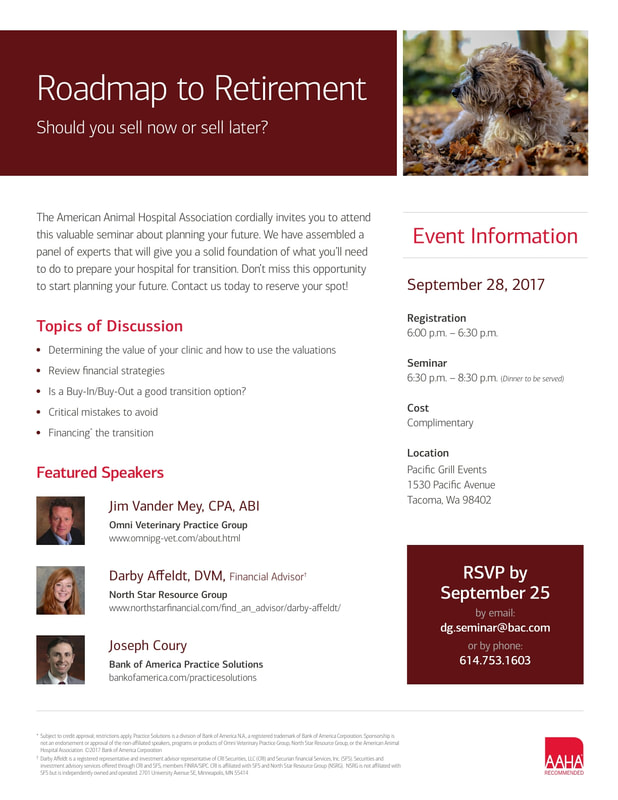
Upcoming Seminar – Roadmap to Retirement: Should you sell now or sell later?
Welcome and Registration: 6:00 p.m. – 6:30 p.m.
Seminar: 6:30 p.m. – 8:30 p.m. (Dinner to be served)
Cost: Complimentary
Location: Pacific Grill Events, 1530 Pacific Avenue, Tacoma, Wa 98402
The American Animal Hospital Association cordially invites you to attend this valuable seminar about planning your future. We have assembled a panel of experts that will give you a solid foundation of what you’ll need to do to prepare your hospital for transition. Don’t miss this opportunity to start planning your future. Contact us today to reserve your spot!
RSVP by September 25 – email dg.seminar@bac.com or call 614-753-1603.
Are Solo Practice Owners Going the Way of the Golden Toad?
When I talk about corporate practices, I’m primarily speaking of the non-dentist owned corporate practice. There are dentist owned practices where a licensed dentist owns 3, 5 or more practices. He or she has full and legal ownership of their practices. I call these small group practices. Corporate practices tip-toe down the legal sidelines of practice ownership by having a dentist own the clinical aspect of the practice, called Dental Services Organization (DSO) and the non-licensed dentist corporation owns the non-dental management aspects, called a Management Services Organization (MSO). Note that this structure can also occur in small groups, but in the small group, a licensed dentist owns both the MSO and DSO. The large corporates include Aspen, Gentle Dental, Pacific Dental Services and others. Both solo practices and corporate practices have their pros and cons from both a patient perspective and from a dentist perspective.
As a patient, I prefer to know who my dentist is going to be when I go into the office. I want to build a relationship with him or her and want my dentist to know the history of my dental care — and a little bit about me as well. In a corporation, you might get the same dentist the next time you go in, but there’s a good chance it will be a different dentist. Small groups lean more towards a solo practice and you will have a reasonably good chance to get the same dentist in the well run small groups.
From a dentist perspective, most dentists do not want to be told what treatment to focus on, what supplies to use, etc., The majority of dentists surveyed by the ADA still have a dream of owning their own practice, being their own boss, making their own decisions.
Recent court decisions in New Jersey, Allstate vs. Northfield, sided on the side of dentists. It may begin to set the tone to start scaring away the non-dentist corporate owners. Washington State has been trying to pass a bill to allow non-dentist owners and so far has been successful. If you’d like to read an article on the New Jersey case, you can read it here.
So, if you have been holding off on not buying a practice because corporates are going to drive solo practices away, think again. There will always be a need and demand for a solo practice. Court cases like Allstate vs. Northfield will help ensure non-dentist owned practices stay away. Join the practice ownership club today!
Economy Helping to Ramp Up Practice Sales
The strong numbers have played a part in the increase in practice sales. Practice owners who are over 55, are seeing the strong numbers and returns in their portfolios and deciding now is the time to retire. Buyers are also watching the economy and realizing it’s a good time to buy a practice. Interest rates are still good at between 5.25% and 5.5%. Consumer’s discretionary income is up freeing funds for consumers to do elective and cosmetic dentistry. (I know you shouldn’t base your dentistry on discretionary income, but many do).
The result of all of this is that practice listings and sales are up. We typically carry an inventory of 10 to 15 practices and we’re now up to approximately 25 practices. We have spoken to other brokers and most are experiencing a similar increase in business. The interesting thing is that valuations are still staying true to normal formulas and historical numbers.
What this means to you is you can either be a participant in this booming market, or you can be a bystander and watch opportunity pass you by. If you would like to get any information on any of our practices, let us know. Consultations and phone calls are always free!
Should you Consider a Low Production Practice to Purchase?
We attempt to coach sellers to sell their practices when they are at their peak productivity and profitability. However, there are a number of doctors, over half, who decide to hold onto their practices while they slow down. They start getting tired, they refer out more procedures, stop marketing and refer more work out to specialists. I have seen practices collecting $350,000 with 600 to 700 active patients and hygiene production at 40% of total production. Analyzing these types of practices to see if they are worthwhile acquisitions or merger prospects requires looking at their procedures report, their production by provider report and profit and loss statement. Turning these practices around and making them more productive may be as simple as stop referring out endo and other procedures that you may be able to do, start marketing and start diagnosing treatment. If the location is good and the numbers look like they can be turned around, you should not disregard these practices for an acquisition or a merger.